
The Kagera wetlands are a landscape of vibrant life, but they also represent a threatened ecosystem. For years, the endangered Grey Crowned Crane conflicted with the immediate economic needs of local communities. However, a new hope is now rising in Murongo village, indicating a future where both nature and the people can thrive. In these wetlands, a quiet transformation is happening: farmers who previously regarded the Grey Crowned Crane as a pest to their crops are now its most dedicated supporters. Thanks to a strategic partnership between Nature Tanzania and the Murongo Farmers Group, sustainable livelihoods and wildlife conservation are being combined via modern beekeeping. This community-driven initiative shows that conserving an iconic bird can be successfully supported through the diligent work of honeybees.
The journey began with a simple desire for change. Inspired by outreach efforts from Community Champion, Mr. Rojas Tumuombe and the Nature Tanzania project officer (Mr. Leonidas Momburi), these farmers first piloted traditional beekeeping. Their aims were twofold: to identify an economic alternative to diversify their income and to protect the Grey Crowned Crane from crop-related conflicts. During a field visit by Partner für Klima und Nature (PKN), and Nature Tanzania in October 2025, the group formally requested support to transition from traditional to modern, high-yield beekeeping methods. With funding from Partner für Klima und Nature (PKN), Nature Tanzania implemented dedicated livelihood support, providing the community with essential technical resources for success. This initiative moved beyond simply supplying equipment; it focused on building genuine community ownership to effectively address human-wildlife conflicts.

Coexistence in Action: A flock of Grey Crowned Cranes foraging in farmland at Murongo Village, Kyerwa District. Understanding and managing interactions between these birds and local farmers is essential for the successful conservation of the Grey Crowned Crane within the Kagera wetlands.
The Beekeeping Training
From November 17–19, 2025, the Korongo group members participated in an intensive three-day beekeeping training workshop led by the Kyerwa District Beekeeping Department and delivered by Ms Jackline Kato Ezekiel, the Kyerwa District Beekeeping Officer. The training program aimed to equip local farmers with the skills needed to manage their apiaries and beekeeping businesses.
The training workshop covered several critical modules delivered, including;
- Farmers learned apiary management, including hive placement and seasonal care. By understanding colony behaviour and flowering cycles, they can now optimise hive strength to coincide perfectly with the full bloom of wetland flora.
- Healthy colonies are the best against environmental stress. The training focused on identifying early signs of colony stress and managing local pests, such as ants, to prevent colony collapse.
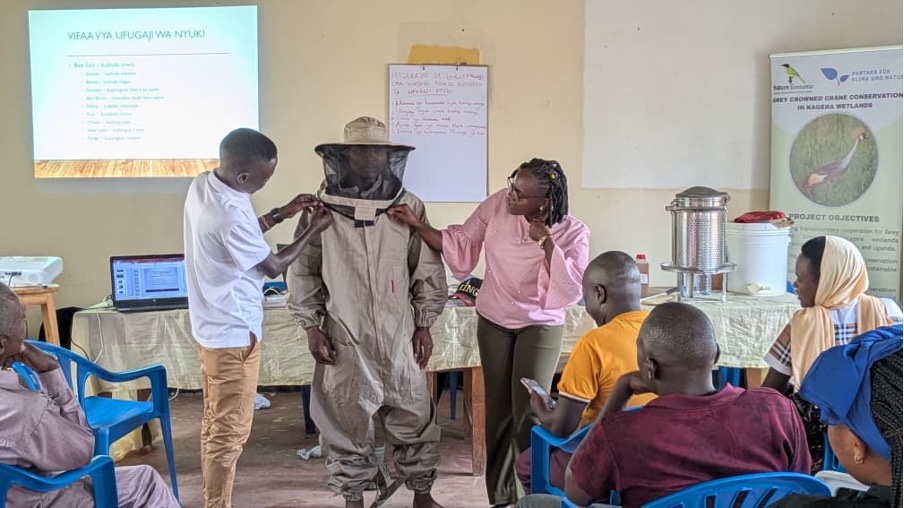
- Professional beekeeping prioritises safety. Demonstrations on using bee suits, veils, and smokers showed the community how to handle bees calmly, helping to reduce agitation for both the beekeepers and the nearby village.

The lead beekeeping trainer (pictured first from right, standing) provides a practical demonstration on the correct use of protective equipment and harvesting tools. This hands-on session is a critical component of the technical training for the Murongo Farmers Group, ensuring safety and precision during apiary management
The Conservation Link: Healthy Wetlands, Productive Hives
The most important part of the program was incorporating beekeeping into conservation efforts. This shift changed the wetland from a “restricted area” to a “vital resource.” Farmers now understand that a healthy, diverse wetland provides the essential nectar and pollen needed for hive productivity. This awareness encourages a voluntary shift away from heavy pesticide use and towards proper management and cautious pesticide use on farms and wetlands. The community recognises that harming bees and Grey Crowned Cranes ultimately affects their income. The wetland is no longer viewed as an obstacle to grazing or farming but as the foundation of a sustainable local economy.

The Kyerwa District Beekeeping Officer facilitating a technical session, while members of the Murongo Farmers Group engage in collaborative discussions to brainstorm and apply modern apiary management principles. This participatory approach ensures that technical knowledge is translated into practical, community-led action to improve livelihoods and conserve wetlands.

We appreciate the active participation of Ibanda-Kyerwa National Park in the beekeeping training to the Korongo Farmers group at Murongo village, Kyerwa District, Kagera region.
Learning from the Best: Insights from Dodoma
Nature Tanzania values the impact of shared experiences. Neema Mwaja, the Program Officer for the Dodoma project, joined the workshop in Murongo village to share insights gained from three years of successful beekeeping in Kongwa and Mpwapwa Districts. Even though Dodoma’s semi-arid landscape differs from Kagera wetlands, the “human” side of beekeeping remains universal. Ms Mwaja highlighted the significance of transparent governance by establishing a formal constitution aligned with local laws, establishing grievance mechanisms, including fair internal conflict resolution, and using the project’s success to advocate for other species, such as the White Stork.

Ms Neema Mwaja, a Program Officer at Nature Tanzania, shares her strategic insights into the success of community-led beekeeping initiatives, drawing on her extensive experience in Dodoma. This regional exchange provided the Murongo Farmers Group guidance on developing a robust governance framework and serving as dedicated ambassadors for wetland conservation.
5. Beyond Participation: True Community Ownership
What happened after the training was more remarkable than the workshop itself. The Murongo Farmers Group didn’t wait for additional assistance; instead, they acted promptly. Members combined their own money to buy materials for an apiary, especially hive beds, and personally cleared the apiary sites. Furthermore, this project has become a catalyst for social change. In a community where physical construction was traditionally reserved for men, the women of Murongo have stepped into leadership and operational roles. From building hive beds and preparing wooden materials to organising tea and food for the whole team, women have shown that household resilience is a shared responsibility.

Men and women of the Korongo Farmers Group work side-by-side to build hive beds for their new apiary. By sharing the physical labour and logistical preparation, the group is laying a resilient foundation for long-term ownership, economic growth and wetland conservation.

Women of the Korongo Group organise essential logistics and welfare duties, like preparing tea and meals, to support the team during beehive stand construction. By ensuring the well-being of the entire team, they help foster a cohesive group where labour and benefits are distributed equitably.
The “Spillover” Success: Empowering Local Artisans
Sustainability extends beyond bees to include the entire supply chain. Importing modern top-bar hives from distant locations such as Bukoba was costly and difficult to organise. To address this and for sustainability, the Kyerwa District Beekeeping Department and Nature Tanzania trained two local carpenters in Murongo and supported them in building hives that meet precise biological standards. The impact was immediate and exceeded expectations: Technical Mastery: Artisans mastered selecting weather-resistant timber and taking precise measurements; After constructing the initial 20 hives for the Korongo Group, they experienced a surge in private orders from Murongo village; other community members have already commissioned 35 more hives. This independent replication is an indicator of sustainability.

A carpenter from Murongo village (pictured in the yellow t-shirt) puts the finishing touches on a top-bar beehive, supported by active members of the Korongo Group. By training local artisans to make equipment that meets strict biological and technical standards, we remove expensive imports and generate a new revenue stream for the community. This ensures that the technical expertise for maintaining and expanding the apiary remains rooted within the village, fostering long-term economic empowerment and self-reliance.
A Remarkable Start: Immediate Colonisation
One of the most encouraging highlights was how quickly nature responded. Many beekeeping projects see new hives remain empty for weeks or months before attracting swarms, but Murongo apiary was an exceptional case. As the team installed 20 hives, bees quickly began colonising them, indicating habitat suitability. The bees’ rapid arrival prompted the team to quickly put on protective gear to safely complete baiting and positioning. Today, we report a 100% colonisation rate, with all 20 hives active, indicating promising productivity. Monitoring is ongoing, and follow-up training is scheduled in four months.

As the Murongo Farmers Group waits to harvest their first batches of “Crane-Friendly Honey,” they are not just securing their economic future—they are ensuring that the Grey Crowned Crane will always have a home in the Kagera Wetlands.
Nature Tanzania extends sincere gratitude to Partner für Klima und Natur (PKN) for their generous financial support, which has been instrumental in the success of this project. Their commitment to sustainable development has empowered the communities of the Kagera Wetlands to integrate modern beekeeping with the conservation of the Grey Crowned Crane.